Meryem Dede
Co-Coordinator
A bill recently passed by our General Assembly demonstrates exactly why collecting money through fees is almost always a losing game. The bill is a great step forward for our state, as it’s poised to eliminate “room and board” fees at our incarcerated work-release centers. When the new bill was introduced, it came with a fiscal note. Fiscal notes in Delaware classically only show how much our government might need to spend (or could lose) in passing a new law; they do not show cost savings. However, through a series of Freedom of Information Act requests, Tide Shift Justice Project has been able to uncover why this fee encapsulates everything that’s wrong with predatory fees– it is going after people who have no money, it punishes those same people when they can’t pay, and it actually is losing our government money because the cost of collecting it is more than the revenue it brings in.
For many years, Delaware’s Department of Correction (“DOC”) has charged people incarcerated at “work-release centers” a room and board fee if they are employed. Our work-release centers (“Level IV”) are largely populated by people who are coming right from prison (“Level V”). (See 11 Del. C. § 4204 (“Such sanctions include . . . partial confinement to a half-way house or restitution center . . .”); see also SENTAC pg. 29.) People at our work-release centers have thus been unable to make market wages before entering these facilities. They have no bank account savings, and in fact, they usually have no bank account. Yet, we charge people at work-release centers $25/week if they are working full-time, and $15/week if they are working part-time.
In the last three years, our DOC has collected on average $40k annually in room and board fees:
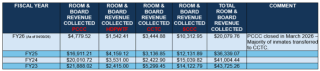
(See TSJP DOC Room and Board FOIA here and here) For context, while the number of people incarcerated in our prisons is ever-fluctuating, Delaware DOC annually reports a “point-in-time” count that reflects an average of 368 people incarcerated during its single-day reporting each year. (See DOC 2025 Annual Report.) For the number of people likely housed annually at these centers, DOC has thus been collecting very little in room and board fees.
One might assume that if a person did not have the money to pay a room and board fee that DOC would not try to collect it. That unfortunately does not seem to be the case. Included in the new bill’s fiscal note is a statement that there is an outstanding balance of $175,894 of uncollected room and board fees. In addition, in researching these room and board fees, TSJP gained access to a report DOC put together on its fees, which reflects the following sanctions for people who fail to pay the fee:
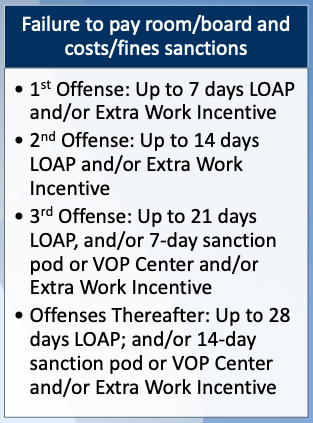
(See TSJP DOC FOIA available here.) This fee was just being charged to people who were in large part “starting over” after a period of incarceration, who couldn’t afford it, and when they couldn’t pay it, they were and are punished.
But it doesn’t stop there. Our Department of Correction studied this fee, and they found that given the staff it took to collect and process the money and the cost of sanctions when people didn’t pay it, they were actually spending hundreds of thousands in labor costs to charge and enforce room and board fees:
__________________
“PCCC,” “HDPWTF,” “CCTC,” “SCCC” reflect acronyms for the state’s Level IV work-release centers, with “PCCC” being the Plummer Center which was recently closed. These numbers reflect that prior to its closure the Plummer Center collected more room and board fees than any other work-release facility. This likely means that the Plummer Center previously had the highest number of incarcerated individuals who were actually able to find jobs. DOC’s policy states that it does not charge room and board fees for people who are not working.
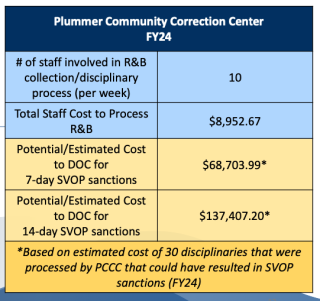
(See TSJP DOC FOIA available here.) Eliminating DOC’s room and board fee will thus directly net our state a cost-savings overall.
Overall, this new bill, when it’s signed into law, will be a huge win for Delaware and for Delawareans. By eliminating room and board fees, we will end a predatory practice that was and is actively harming people who are trying to reenter our society and will even save our state money.